A practical handbook · English edition
Medical Visibility
SEO, AEO and GEO for healthcare websites
A handbook on how a medical website gets found in search, chosen as a direct answer, and cited when an AI system writes the answer, without giving up evidence, patient privacy or measured language. It is written by a practicing urologist who builds and runs his own medical sites.
It is for physicians, health professionals and clinics, and for the people who do SEO for healthcare, in the United States and Europe.
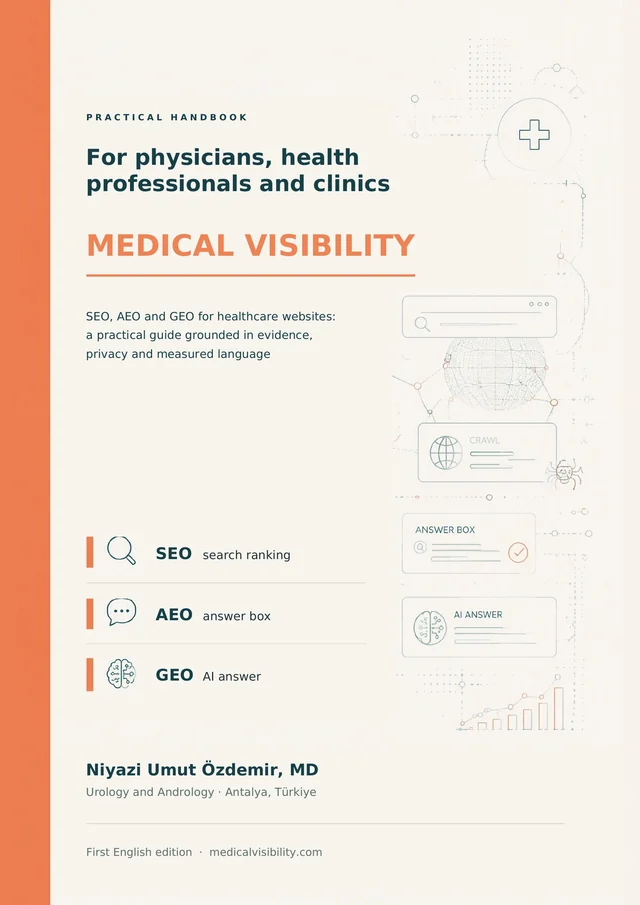

The handbook
Medical Visibility: SEO, AEO and GEO for Healthcare Websites
A Practical Handbook, by Niyazi Umut Özdemir, MD. Sixteen chapters, a glossary, and an appendix on advertising rules, data protection and medical ethics online.

The last page of the book carries the access code for the full version of the checker. Before buying, you can browse the preview on Google Books.
What the book is
A working handbook, not a theory book. It starts from the technical groundwork a medical
site needs before any content, then moves through site architecture, a
25-rule standard for medical articles, and the schema and entity records that tie each
article to its author and the author to the organization through @id.
It goes on to local visibility, measurement with Search Console and analytics, how to read visibility in AI answers (AEO and GEO), keeping content up to date, and video. Each chapter ends with a checklist, so you can open your own site, make one change and note what you changed.
A regulatory layer written for the United States and Europe runs alongside: FTC-style substantiation of claims, state medical boards, HIPAA, GDPR and the EU MDR. It is general guidance, written to help you ask the right questions of your own regulator and counsel.
- 16 chapters
- Glossary
- Appendix on advertising and data protection
- US and Europe
- 00Ground zero: technical groundworkThe base that has to be laid before any content
- 01SEO, AEO and GEOThree separate questions, three different surfaces
- 02Site architectureThe decisions that cost the most to undo later
- 03Writing rules for the blogGiving the right information in the right order
- 04Supporting structuresThe invisible layer that decides the outcome
- 05Measurement infrastructureAnalysis on broken data is worse than no analysis
- 06Reading AI visibilityCitations, mentions, position and share of voice
- 07Conversion measurementTraffic and demand are not the same thing
- 08The ten most common mistakesSo that the same ones do not get made twice
- 09Continuous workKnowing the lag, keeping the patience
- 10The monthly, quarterly and annual routineAn indicator nobody looks at is worth nothing
- 11The demand model and patient equivalenceThe assumptions that turn a click into a patient
- 12Business profile and map visibilityThe second front door, outside your site
- 13Social media and videoSetting the expectation right
- 14Site migration and redesignThe job that is hardest to undo, done in order
- 15Working across languages and bordersThe rules follow the audience, not the address
- APP.Advertising rules, data protection and medical ethics onlineGeneral guidance on truthful claims, patient privacy and measured language

Formerly NotebookLM
Give the book to AI as a source
The book is sold without DRM, so the PDF or EPUB file you get from Google Play Books can be added to Gemini Notebook as a source. You can then ask questions across the whole book, have the chapters that concern your own site summarized, and adapt the checklists to where you stand. Answers are drawn from the sources you add and point back to the passages they come from.
Adding Google Play Books titles directly as a source currently covers only the catalogs of participating publishers. For this book, the route that works is uploading the file yourself, and that route is open today.
notebooklm.google
Medical Visibility Checker
The free companion tool of the handbook. Paste a medical article, or give the address of a published page, and the checker audits it against the book's 25 rules. It shows which rules the article meets today; it does not predict rankings.
25 rules
Structure, the opening sentence, the focus phrase, the heading hierarchy, required medical content blocks, links, image alt text and the number of calls to action.
Critical rules
Some rules are marked critical. If one of them is missing, a high score does not make up for it, and the checker says so directly.
Advertising rules scan
Flags risky advertising language in the text, with separate notes for the United States and for Europe. You choose the region.
Schema link map
Draws the JSON-LD records on a published page and shows whether article, author and organization connect through @id, with a warning where a link is broken.
Passage analysis
AI systems quote passages, not pages. The checker splits the article by subheading and asks whether each passage answers a question and can be understood on its own.
Your text stays in your browser
The audit runs on your device and the article text is not sent anywhere. When you ask it to fetch a published page, only the address is sent.
Open to everyone
No sign-up. Paste an article and see which of the 25 rules it meets and where the gaps are.
Unlocked by the code in the handbook
The access code on the last page of the book unlocks the full version: how to close each gap, the advertising rules scan, the schema link map and the detailed report. The same code also opens the ledgers of the two tools below.
For medical content pages. Do not paste identifiable patient information. The scans are pattern matches; the final call is always the physician's.
Two more tools with the handbook
Check your links, test your AI visibility, track both monthly
Both tools are free to use. The access code in the handbook adds a ledger to each, so you can repeat the same checks every month and see what changed. Everything you save stays in your browser.
Link checker
Enter a page that is said to link to your site. The tool opens it, finds the link and shows its anchor text and whether it is dofollow, nofollow, sponsored or ugc, so you know whether it passes value.
With the book: link ledger. Keep every verified link in one list and re-check them all once a month; links whose status changed are flagged.
Open the link checkerAI visibility test
Builds fifteen questions a patient might ask an AI assistant about your specialty and city. You ask them yourself and mark whether you were named or cited. The tool does not query any AI service.
With the book: tracking ledger. Mark each assistant separately, save a measurement every month, and print a charted report of how the answers change.
Open the AI visibility testFree training video
Video title
About the author
Written by a physician who does the work himself

Niyazi Umut Özdemir, MD
Urologist
Urology and Andrology · Antalya, Türkiye
He wrote the handbook and built its companion checker. He builds and runs his own medical websites and handles their content, measurement and technical work himself. The book is written from that practice: what he learned by doing it, and the care a physician owes the reader on the other side of the screen.
This work is run separately from the author's clinical practice.